 Rivello
A Timeless Village with Two Identities
municipality of rivello
(Province di Potenza)
Altitude
m. 479 s.l.m.
population
2439 (447 in the borgo)
saint patron
San Nicola di Bari, 6 dicembre
turist information
Piazza Umberto I
Ph. 097346004
E-mail: visit-rivello@libero.it
INSTAGRAM: visit_rivello_italy
FACEBOOK: https://www.facebook.com/comunedirivello.pz.it/
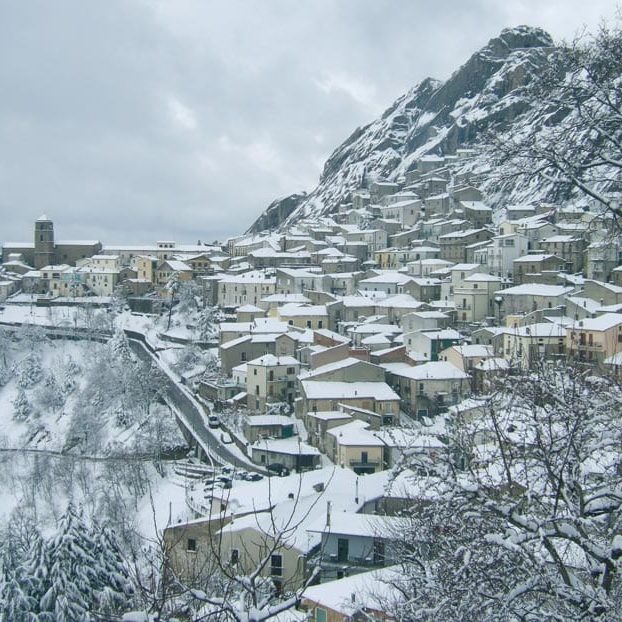
Nestled on three hills overlooking the Noce River Valley, Rivello is a picturesque village where time seems to stand still. Its maze of narrow streets, winding stairways and covered passageways opens onto breathtaking views of mountains and valleys. The village’s dual identity reflects the presence of the Lombards, who settled on the upper hill around the Latin-rite Church of San Nicola, and the Byzantines, whose Greek-rite community gathered around Santa Maria del Poggio on the lower hill.
According to local tradition, the name Rivello recalls ancient Velia and the refugees believed to have founded Re-Velia. The town’s historic motto, “Iterum Velia Renovata Rivellum”, celebrates this connection. Later renowned for its copper and gold craftsmanship, bells, church organs and tower clocks, Rivello now welcomes visitors with red-roofed houses, artistic treasures and a landscape of extraordinary beauty.
- Church of San Nicola: a Romanesque church with an eighteenth-century stone staircase and an ancient crypt supported by 34 stone columns.
- Church of Santa Maria del Poggio: dramatically perched on a cliff, the spiritual heart of the former Greek-rite community.
- Convent of Sant’Antonio da Padova: founded in 1512, with remarkable frescoes, Giovanni Todisco’s Last Supper (1559) and an archaeological exhibition.
- Also worth visiting are the Chapel of the Annunziata, the churches of Santa Barbara and Santa Maria del Popolo, and historic Palazzo Megale.
Local specialities include laghene e fasule sfritte (handmade pasta with beans), ciambotta (vegetable stew), cuccìa (a traditional soup of legumes and grains) and polenta with sausage. The prized local cured meat is soperzata, a delicately spiced sausage documented since 1719.
- Polifonie Music Festival: concerts, masterclasses and music in the historic centre.
- Food and Wine Trail: local dishes, wines, desserts and live music along the village streets.
- White Night of Transhumance: traditional food, Podolica beef tastings and folk music.
- Feast of Sant’Antonio da Padova, 13 June: religious procession with traditional Cende and an evening of music.
Hiking trails around the village reveal its heritage and scenic surroundings. Enjoy canyoning in the Bitonto stream or river trekking along the Noce River (booking required), picnic areas beside the river and the Rotale lakes, and nature walks on the slopes of Mount Sirino and Mount Coccovello or towards the Echo Gorge of San Costantino.